
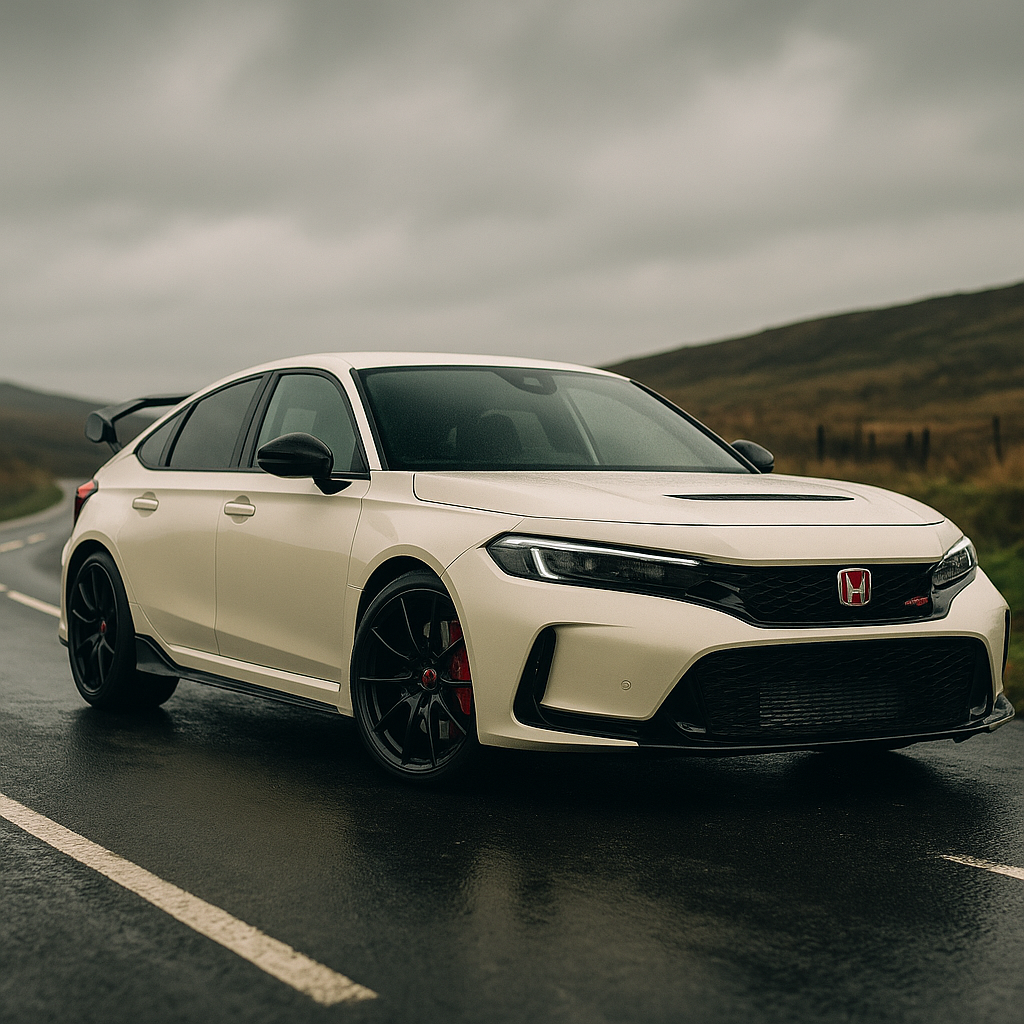
The Honda Civic Type R has never really cared about being subtle. That wing. Those exhausts. The whole thing looks like it escaped from a touring car paddock and someone forgot to confiscate the number plates. But underneath all that visual aggression is a car that has spent two decades genuinely earning its reputation. The question for 2026 is whether it still earns it on British roads, which as any driver who has scraped a sump on a collapsed B-road will tell you, are an entirely different proposition to the smooth Japanese test routes where most performance cars find their confidence.
What’s new for 2026 and what you’re actually buying
Honda has kept the current generation (FK8’s spiritual successor, the FL5) largely intact for 2026. You get a 2.0-litre turbocharged VTEC engine producing 329bhp, channelled through a six-speed manual gearbox to the front wheels. No dual-clutch option, no paddle shifters, and Honda remains absolutely unapologetic about that. The three driving modes (Comfort, Sport, and +R) now feature recalibrated damper settings following feedback from European owners, which is where the British road test story gets interesting. There’s also a limited Pikes Peak edition doing the rounds, but at around £52,000, that’s a conversation for another day. Standard car is priced from £47,995, which is significant money for a front-wheel-drive hatch, but let’s see if it justifies itself.
Ride quality on British tarmac: the real test
Comfort mode first, because that’s where most people will spend most of their time. On a decent A-road, the Type R in Comfort is genuinely acceptable. The adaptive dampers take the edge off expansion joints and medium-sized potholes reasonably well, and the 20-inch Michelin Pilot Sport 4S tyres have enough sidewall to absorb some of the mess. But push it onto a typical Midlands B-road with its cocktail of patched tarmac, drain covers at odd angles, and the kind of surface degradation that makes suspension engineers weep, and the car starts to feel taut in a way that occasionally crosses into uncomfortable. Sharp edges transfer into the cabin. You feel it in your lower back on longer stretches. The 2023 model had this exact problem, and while the recalibration helps slightly, it hasn’t been fixed entirely. If you’re buying a Type R as a daily driver on rough urban roads, that’s worth knowing before you sign anything. The issue of road surface quality isn’t unique to this car, of course. UK pothole damage is affecting suspension across the whole modern car range, and the Type R’s stiff underpinnings mean it feels that damage more than a Golf GTI with its softer default setup.
Motorway refinement and long-distance ability
Here the Type R surprises. At a steady 70mph on the M6, it’s genuinely relaxed. Wind noise is well managed given the aero appendages, the gearbox sits in sixth without hunting, and the seats, which look like they belong in a racing simulator, are actually supportive over long distances in a way that many sports car seats fail to be. Fuel consumption at motorway speeds sits around 34-36mpg in real-world driving, which is respectable for 329bhp. The cabin itself is better than it was. The digital instrument cluster is clear, the infotainment system responds quickly, and Honda has binned the worst of the previous generation’s plastic trim. There’s still a slight afterthought quality to some of the switchgear, particularly around the centre console, but at this price point that criticism carries some weight. On a four-hour motorway run, I didn’t arrive tired or irritated. That’s the test, and it passes.
How it drives when you actually push it
This is where the Type R justifies every penny and every aggressive body panel. The steering is a proper communicative rack, one of the best you’ll find on any front-wheel-drive car, full stop. You know exactly what the front tyres are doing at all times, and in Sport mode the whole car sharpens up into something that feels alive in the way that modern performance cars increasingly don’t. The six-speed manual has a short, positive throw, and Honda’s rev-hang reduction over previous generations means gear changes feel natural and quick. Understeer exists, as it must with front-wheel drive and this much power, but the limited-slip differential manages it superbly through corners. Push hard and the car rotates more than you’d expect, aided by the rear-biased weight distribution that Honda has engineered through clever packaging. The Nurburgring front-wheel-drive lap record still belongs to a Type R, and after a day on B-roads and a track session at Bedford Autodrome, it’s obvious why. This thing is properly, deeply fast in the right hands.
Hyundai i30 N and Golf GTI: how the rivals compare
The Hyundai i30 N is cheaper at around £37,000 and arguably more characterful in an analogue way. Its manual gearbox has a brilliant mechanical feel, the ride is slightly more forgiving on rough roads, and the overall package is easier to live with daily. But it gives away about 30bhp and the Type R’s steering is simply in a different class. If you’re buying for pure driving enjoyment, the Honda wins. The Golf GTI is a different proposition entirely. Volkswagen’s long-running hot hatch benchmark is quieter, better built in terms of interior fit and finish, more comfortable, and easier to sell your partner on. But the GTI Performance (around £44,000) makes only 261bhp, and while it’s a polished, refined machine, it lacks the Type R’s rawness and driver engagement. If the GTI is a precision instrument, the Type R is a weapon. Which one you want depends entirely on what you’re using it for. The GTI suits someone who wants a fast car that doesn’t announce itself. The Type R is for the driver who already knows every lap record, planned a track day for their birthday, and doesn’t really care what the neighbours think about the wing.
It’s also worth comparing the Type R’s running costs in the broader context of 2026 ownership. Car insurance in 2026 remains expensive for performance vehicles, and the Type R sits in group 50 (out of 50), so factor that into your budget. Drivers with clean licences in their late twenties can expect to pay £1,800-£2,400 per year depending on location and insurer. London-based owners should brace for more.
Everyday usability: can you actually live with it?
The boot is a genuine 420 litres, which is bigger than a standard Civic thanks to the flat rear floor. Rear headroom is acceptable, the back seats can fit adults on shorter journeys, and the front seats have enough adjustment range for most body types. In Comfort mode through town, the car is manageable. Visibility out the back isn’t brilliant thanks to the large spoiler, but parking sensors are standard and the reversing camera gives you enough to work with. The 2026 model year also brings wireless Apple CarPlay and Android Auto as standard, which removes one of the previous generation’s more irritating omissions. For what it is, the Type R is a surprisingly practical daily driver. If you’re comparing it against something like the Toyota GR86 or Mazda MX-5 for the enthusiast end of the market, the Type R wins on usability by a significant margin, while remaining the more serious driver’s machine on track.
According to the Honda Racing Corporation, the Civic Type R’s development programme involves direct collaboration with the motorsport division, and that lineage shows in every aspect of how the car behaves when pushed. It’s not a marketing claim built on filtered Nurburgring footage. The connection is real and you feel it.
Verdict
The Honda Civic Type R in 2026 remains the most capable front-wheel-drive hot hatch you can buy in the UK. It’s not the most comfortable, not the most refined, and certainly not the cheapest. But for sheer driver engagement, steering feel, and lap time, nothing this side of £50,000 touches it with a front-wheel-drive layout. The ride on genuinely rough British roads is still a compromise, and if you commute daily on broken urban tarmac, the Golf GTI will treat you better. If you track it, B-road it, and want a car that feels like a reward every single time you drive it, the Type R is still the one.
Frequently Asked Questions
How much does the Honda Civic Type R cost in the UK in 2026?
The 2026 Honda Civic Type R starts at £47,995 in standard specification. Limited editions such as the Pikes Peak version sit above £52,000. Honda offers PCP finance through Honda Financial Services, which brings monthly costs into a more manageable range for most buyers.
Is the Honda Civic Type R comfortable enough as a daily driver on UK roads?
In Comfort mode, the Type R is liveable on most UK roads but remains firm compared to something like a Golf GTI or even a Hyundai i30 N. Rough urban tarmac and pothole-heavy B-roads will transmit more impact into the cabin than rivals. If your commute involves particularly broken surfaces, that’s a genuine consideration before buying.
How does the Honda Civic Type R compare to the Golf GTI in 2026?
The Golf GTI Performance makes 261bhp compared to the Type R’s 329bhp, and is quieter, more refined, and more comfortable. The Type R is faster, more engaging to drive, and better on track, but the GTI is easier to live with daily. They suit different types of driver.
What insurance group is the Honda Civic Type R in?
The Honda Civic Type R sits in insurance group 50, the highest group available. Annual premiums vary widely based on age, location, and driving history, but most UK drivers can expect to pay between £1,800 and £3,000 or more per year. Younger drivers or those in cities like London should get quotes before committing.
Does the Honda Civic Type R still hold the front-wheel-drive Nurburgring lap record?
Yes, as of 2026 the Honda Civic Type R holds the front-wheel-drive production car lap record at the Nurburgring Nordschleife, set during the FL5 generation’s development programme. This record has been a consistent benchmark for the model across multiple generations.